3.8 Million Vehicles Got Recall Letters This Week. The Deadliest Cars in America Did Not.
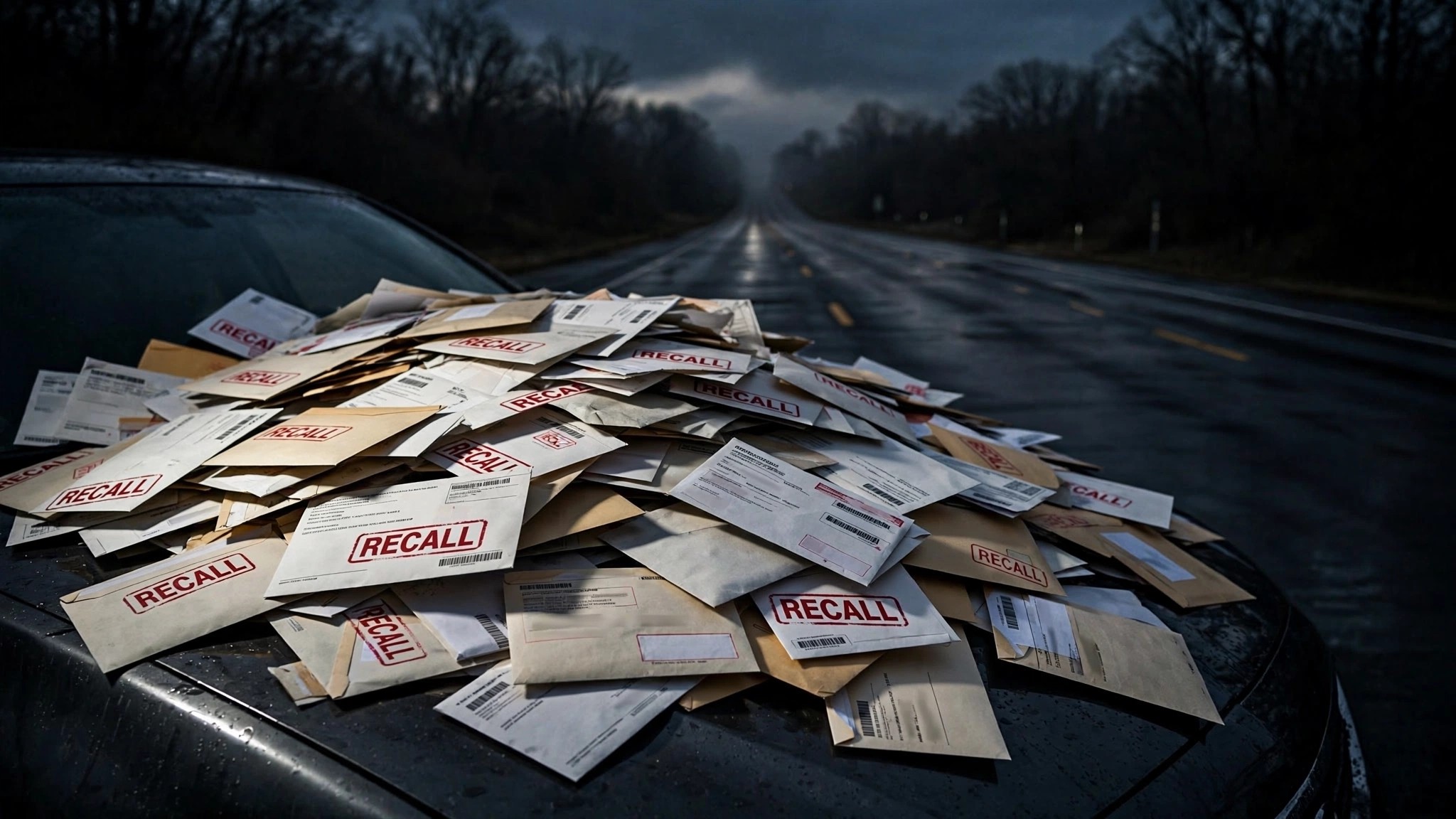
Between June 9 and June 11, NHTSA published recall notices covering approximately 3.8 million vehicles.[1] Jeep Wranglers and Gladiators (1.3 million, power steering pump wiring, 72 fires). Honda CR-Vs and Accord Hybrids (1.05 million, sealant bottle cap becomes a projectile). Honda Pilots, Ridgelines, Passports, and Acura MDXs (880,000, rear subframe corrosion). Ford Expeditions (548,000, chrome trim peeling into blades). Chrysler Pacifica Hybrids (17,000, battery fire risk, third recall for the same failure mode). Big week for the mailroom.
Run every recalled vehicle through ten years of FARS data and you get a weighted average fatality rate of 0.83 deaths per 100 million vehicle miles traveled.[2] Below the national fleet average. Honda's CR-V sits at 0.53, its Pilot at 0.29, Chrysler's Pacifica at 0.19. Among the safest vehicles on American roads by the only federal metric that counts bodies.
Now run the ten deadliest vehicles in FARS: Chevy Impala at 5.00, Ford Mustang at 6.02, Chevy Cobalt at 5.10, Nissan Maxima at 5.11, averaging 5.32 per 100M VMT across the ten worst performers. None of them received a letter this week, none will receive one next week, and no recall mechanism can reach them, because nothing about them is broken.[2]
This is the structural gap at the center of American vehicle safety regulation, and the math exposes it cleanly: 6.4 times. Vehicles recalled this week kill at one-sixth the rate of vehicles that were not.
NHTSA's recall authority, codified under 49 U.S.C. §30118, covers defects. A defect is a departure from design intent. When a Wrangler's power steering pump wiring chafes against a bracket and catches fire, that is a defect. Jeep did not design the wire to contact the bracket. When a Pacifica's battery pack overheats for the third time under the same failure mode, that is a defect Chrysler has now failed to fix twice.[3] These are manufacturing and engineering errors, correctable at the dealer, and NHTSA has the statutory tools to force the correction.
A Chevy Cobalt killing occupants at 5.10 per 100M VMT is not a defect. GM designed it to weigh 2,700 pounds, cost $15,000, and compete in the subcompact segment, and the car performed exactly as designed. Physics dictates what happens when a 2,700-pound unibody meets a 5,500-pound pickup truck at a rural intersection, and the Cobalt delivers those outcomes with the kind of precision that no engineer would claim as a feature but no regulator can call a malfunction. No recall letter exists for "your vehicle is small, light, and statistically deadly by a factor of six compared to the Honda Pilot that just got recalled for a bottle cap," because NHTSA does not have that authority and nobody else does either.
Consider the Ford Mustang, which exemplifies the other category of unrecallable lethality. At 6.02 deaths per 100M VMT it ranks among the deadliest vehicles in the FARS dataset, but its kill rate traces primarily to driver behavior rather than structural inadequacy, because Mustangs attract a driver demographic that FARS documents thoroughly in its toxicology tables: younger, faster, more frequently impaired, buying a car that rewards the worst instincts of people least equipped to manage them. You cannot recall a customer base, and you cannot issue a technical service bulletin for poor judgment at 2 a.m. Its 6.02 rate is a composite of vehicle design, driver selection effects, and use patterns that no recall mechanism can decompose or address.
Strongest counterargument, stated without dilution: recalls and fatality rates operate on orthogonal axes, where one fixes a specific, identifiable manufacturing or engineering failure that a manufacturer can remedy, while the other reflects decades of vehicle design choices, driver demographics, road environments, and crash physics that no single intervention can alter. Criticizing the recall system for not addressing fatality rates is a category error. NHTSA publishes NCAP star ratings, IIHS publishes crashworthiness data and Top Safety Picks, and the information exists for buyers willing to seek it.[4] Recall authority was never designed to be a fatality reduction program; it is a quality control mechanism, and quality control mechanisms work within their scope.
That counterargument is correct on its own terms, and it entirely misses the point.
When NHTSA announces 3.8 million recalls in a week, it generates headlines that read like the agency is protecting the public, and the sheer volume creates an impression of comprehensive oversight that consumers internalize as safety. Institutional framing reinforces this: NHTSA's own language describes its recall authority as central to its safety mission. But recall completion rates tell a quieter story, with the weighted average across all NHTSA recalls from 2012 to 2022 landing at 65.8 percent, meaning one in three recalled vehicles never gets fixed.[5] For large SUVs, completion drops to 33 percent; for mid-premium sports cars, 31 percent. Impressive volume numbers, a third of the problem unresolved, on vehicles that were already among the safest on the road.
Meanwhile, Impala's 3,774 deaths over a decade generate no letters, no dealer appointments, no NHTSA press releases. Honda's Accord, at 3.07 per 100M VMT, has accumulated 7,102 fatalities in FARS, roughly four times the raw death count of the Jeep Wrangler that just got recalled for 72 fires among 1.3 million vehicles.[2] Wrangler's fire rate: one in 18,000, while Accord's fatality rate runs three times the fleet average, and only one of those two numbers triggered a federal response.
Limitations worth stating: FARS aggregates 2014 through 2023 data, and many of the "deadliest" vehicles include discontinued models whose high rates partly reflect aging fleets and aging drivers. Comparing recalled vehicles to high-fatality vehicles is illustrative rather than causal, because a rigorous analysis would need to isolate defect-attributed deaths from design-attributed deaths, a distinction FARS does not code for. Recall completion rates vary by recall type, vehicle age, and manufacturer, so the 6.4x gap represents real arithmetic from real federal data whose policy implications require more granularity than FARS provides.
Still: the recall system works, catching 72 Wrangler fires before they became 720 and flagging Honda's subframe corrosion before control arms started separating on the interstate. Genuine interventions preventing genuine harm, and nobody should stop checking their VIN at nhtsa.gov/recalls.
But 3.8 million letters went out this week to vehicles that kill at 0.83 per 100M VMT, while zero letters went to vehicles that kill at 5.32. Recall regulation is a flashlight pointed at the safest corner of the parking lot, because that corner has a definition of "broken" that the law can act on, and in the dark corner where the body count actually accumulates, nothing is broken because everything is functioning as designed.
If you are shopping for a used car: NHTSA's recall database tells you whether your vehicle has an outstanding manufacturing defect. It does not tell you whether your vehicle was designed to protect you in a crash. For that, check IIHS crashworthiness ratings at iihs.org/ratings, compare FARS fatality rates at this site, and understand that the safest vehicles in the recall database are often also the safest vehicles on the road. A recall letter is not a danger signal. An absence of one is not a safety endorsement.
Sources & References
- Reuters, NHTSA recall notices: 26V362000 (Jeep Wrangler/Gladiator), Honda CR-V/Accord Hybrid tire kit, Honda Pilot/Ridgeline/Passport/MDX subframe, Ford Expedition chrome trim, Chrysler Pacifica Hybrid battery, June 9–11, 2026. nhtsa.gov/recalls
- NHTSA, Fatality Analysis Reporting System (FARS), 2014–2023. Vehicle-specific fatality rates per 100M VMT. nhtsa.gov
- NHTSA, Chrysler Pacifica Hybrid battery fire recall, June 2026. Third recall for same failure mode (prior campaigns 2022 and 2024). 17,277 vehicles, 2020–2022 MY. nhtsa.gov/recalls
- IIHS, Vehicle Ratings and Top Safety Picks. iihs.org/ratings
- NHTSA, Annual Recalls Report, 2024. Weighted average recall completion rate 2012–2022: 65.8%. Congressional testimony (S.Hrg. 112-330) for segment-specific completion rates. nhtsa.gov