The Toyota Land Cruiser Has a Higher Death Rate Than a Mustang. Nobody Talks About It.
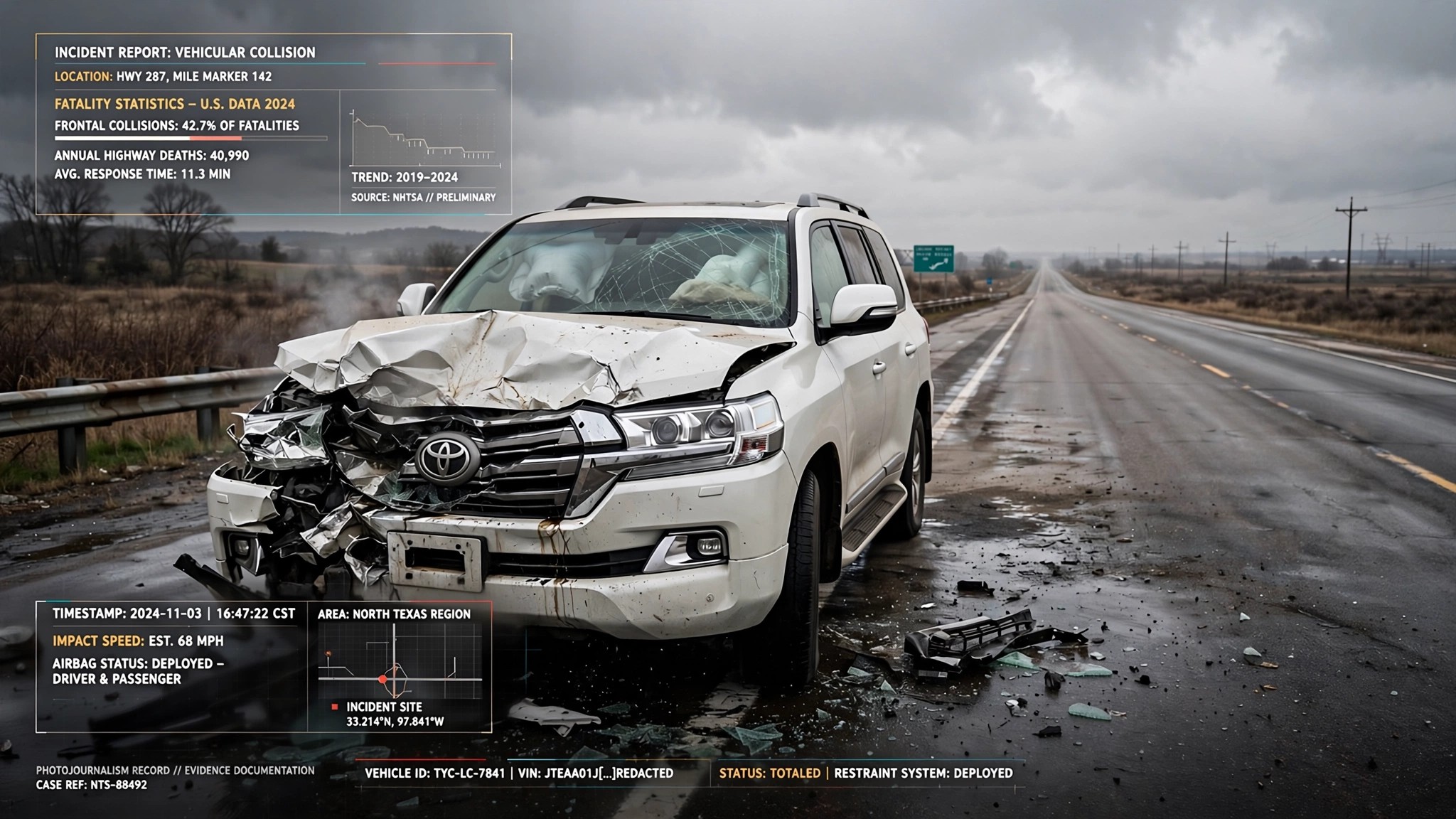
Two weeks ago the IIHS crashed a 2026 Toyota Land Cruiser into a deformable barrier at 40 mph and scored the result "Marginal." The rear-seat dummy's head slammed forward into the front seatback, and the lap belt migrated from the pelvis to the abdomen, exactly where it causes the most internal damage.[1] Toyota's $56,000 fortress couldn't protect a crash-test mannequin sitting behind the driver. That's embarrassing. What the FARS database reveals about the Land Cruiser's real-world track record is worse.
Run the numbers on 343 Land Cruiser fatalities across a decade of FARS data and you get a death rate of 6.27 per 100 million VMT.[2] Only the discontinued Chevrolet Tracker (7.83) is higher among SUVs. For context, the Jeep Wrangler sits at 0.84. The Toyota 4-Runner, which shares the Land Cruiser's platform lineage, manages 1.00, and the RAV4, Toyota's best-selling crossover, posts a barely-visible 0.19. A Ford Mustang, the car your insurance company prices like a death wish, comes in at 6.02. Driving a Land Cruiser in America is statistically deadlier per mile than driving a muscle car with a live rear axle and a demographic skewing toward twenty-three-year-olds who watched too much Fast & Furious.
The instinct is to blame the driver, but the toxicology data kills that theory cleanly. Only 8.9% of Land Cruiser drivers in fatal crashes tested positive for any impairment, alcohol or drugs combined.[3] For comparison, 4-Runner drivers posted 20.6% impairment in fatal crashes, and they still die at one-sixth the rate. Land Cruiser occupants in FARS weren't partying; they were sober, probably affluent given the price tag, and dead anyway.
Before you draft the angry email: yes, the fleet is small. Toyota sold roughly 3,000 to 5,000 Land Cruisers per year in the US before discontinuing the model in 2021, and the estimated fleet of 43,750 vehicles means the rate carries wide uncertainty, potentially ±30% or more. A few dozen additional crashes in either direction would move that 6.27 meaningfully. But 343 people are still dead. And the IIHS just demonstrated that the brand-new 2026 model has a structural weak point in the exact crash scenario that kills rear-seat passengers at scale, which is the moderate-overlap frontal collision, one of the most common real-world crash configurations.[4] The 4-Runner scored Marginal in the same test, and so did the Highlander and Sienna. The Lexus RX, another Toyota platform, scored Poor. This is not one vehicle failing one test; this is Toyota's rear-seat restraint engineering producing a pattern across its entire SUV and crossover lineup.
What you should do with this information depends on where you sit. If you own a Land Cruiser and regularly carry passengers in the back seat, the IIHS result should concern you more than the FARS rate, because the 2026 test identifies a specific, reproducible failure mode in crash protection that Toyota has not yet addressed across its platform family. If you're shopping for a $55,000+ SUV and believe "Toyota" and "safe" are synonyms, cross-reference the IIHS ratings page before you sign. The Subaru Ascent and the Rivian R1S both earned Top Safety Pick+.[5] The Land Cruiser earned nothing, because durability is not safety. Surviving a decade of African bush roads does not mean the structure distributes crash energy correctly at highway speed in suburban Ohio. Toyota built a vehicle that will outlast your grandchildren. It just might not protect them in a crash.
Sources & References
- Autoblog, “Toyota Land Cruiser Is Tough, But One Crash Test Exposed A Weak Spot,” May 21, 2026. autoblog.com
- NHTSA, Fatality Analysis Reporting System (FARS), 2014–2023. Estimated fleet from US vehicle sales data; VMT from NHTS annual miles. nhtsa.gov
- FARS Toxicology data, 2014–2023. 417 Land Cruiser drivers in fatal crashes; 37 tested positive for any impairment (8.9%). cdan.dot.gov
- IIHS, “Moderate overlap front crash test,” updated 2022 to evaluate rear-seat protection. iihs.org
- IIHS, 2026 Top Safety Pick+ award recipients. iihs.org