UL Burned 18 Cars. The Fire Blanket Made Things Worse.
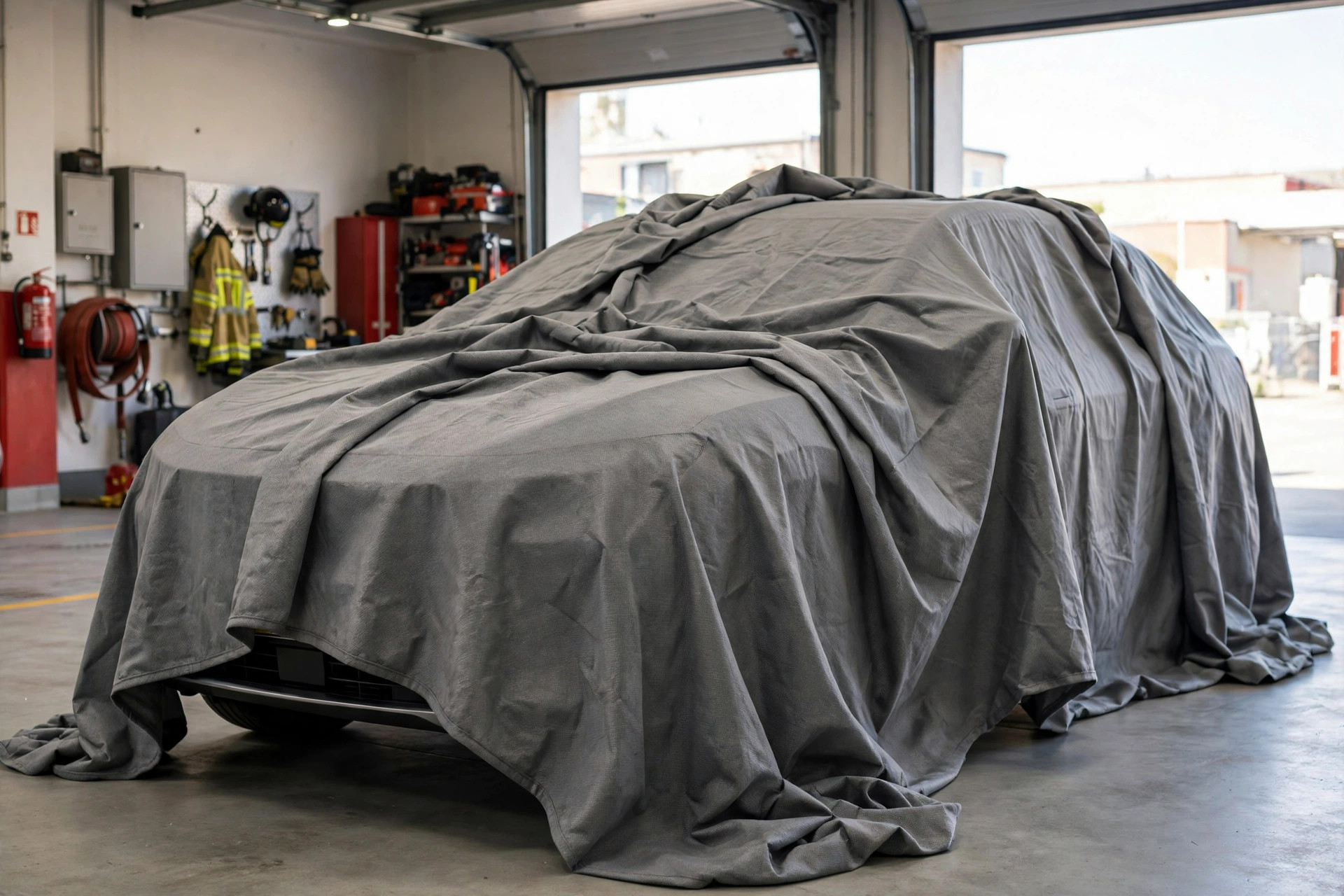
Somebody at UL Research Institutes spent months setting cars on fire under controlled conditions, measuring exactly what happens when lithium-ion battery packs undergo thermal runaway, and testing whether the $300 fire blanket you bought for your garage actually does what the marketing claims. It can trap flammable gases underneath and create a deflagration risk — an explosion hazard that nobody put on the product page.[1]
Straightforward and brutal study design. Nine vehicles burned freely so researchers could establish a baseline. Nine more burned while crews tested three suppression approaches: water only, fire blankets, and water combined with an added chemical agent designed specifically for lithium-ion fires. Every EV was fully charged, fires were initiated with a propane burner targeting the battery, and researchers let the blaze grow for six minutes before starting suppression, replicating the standard fire department response time across North America.
First finding, and this one should reframe the entire public conversation: EV fires and gasoline vehicle fires are essentially identical in fire growth rate, peak fire size, and fire duration. EVs released more total energy on average, which the researchers attributed entirely to greater vehicle mass and not to any inherent property of the lithium-ion battery chemistry that the public discourse has spent years catastrophizing about. Fire behavior was identical. So the next time someone tells you EVs are rolling bombs while gas cars are perfectly safe, point them to Figure 12 of the FSRI report, where the heat-release curves overlap so completely you'd need a legend to tell the two vehicle types apart.[1]
Now the uncomfortable part. Yes, fire blankets did control visible flaming, and that much is true, and it is what they are marketed to do, and it is what looks reassuring in a product demo video shot in an open field with a camera crew and a publicist standing just out of frame. But beneath the blanket, the battery was still in thermal runaway, still venting gases, and those gases were accumulating in the enclosed space between blanket and vehicle. Researchers documented a deflagration event, which in plain language means the trapped gases ignited all at once in a rapid pressure wave that would have sent shrapnel, burning debris, and superheated air outward through any residential garage in a radius measured in feet, not inches. In a garage, that is catastrophically worse than the fire you started with.[1]
Nothing stopped it: no tested suppression method halted thermal runaway. Not water, not blankets, not the fancy chemical agents that cost ten times more and performed no better in every test UL ran. Added suppression agents performed identically to plain water. Once a lithium-ion battery pack decides to eat itself, the only honest strategy is to control the surrounding fire, protect exposures, and let the pack burn out. That expensive extinguishing foam your HOA considered mandating for the parking garage? Performs like garden-hose water, except it costs forty times more per gallon and gives your parking committee the warm feeling that they did something proactive at the last board meeting.
This matters because the public narrative around EV fire safety has been dominated by two equally wrong camps, both of which have been screaming at each other on social media and in city council meetings and at HOA board votes for the better part of five years. Camp one insists EVs are uniquely dangerous fire hazards that will incinerate your home, your children, your pets, and probably your neighbor's house for good measure. Camp two insists EV fires basically never happen and anyone worried about them is a Luddite who still thinks cell phones cause brain cancer. FSRI data says both are wrong. Battery electric vehicles catch fire at a rate of roughly 25 per 100,000 sold, compared to 1,530 for gasoline vehicles and an eye-watering 3,475 for hybrids, which carry the failure modes of both architectures simultaneously.[2] EVs burn less often. When they do burn, they burn about the same as a gasoline vehicle in every measurable respect. But the tools marketed to address that burn are inadequate at best and, in the case of fire blankets deployed in enclosed residential garages, potentially explosive at worst.
Another buried finding, the contamination data, is the kind of result that should change standard operating procedure for every fire department in the country. Elevated concentrations of metals and particulate fluoride showed up in the smoke, the suppression runoff water, and on firefighters' turnout gear. Full PPE and self-contained breathing apparatus are required throughout the entire incident, including during the overhaul phase when most firefighters would normally strip masks and go to work with gloved hands only. Standard fire-scene cleanup protocols that work for gasoline fires do not account for battery-specific contamination.[1]
What you should actually do: If you park an EV in an attached garage, a connected smoke detector and a garden hose are more useful than a fire blanket. If you own a fire blanket, do not use it in any confined or enclosed space. If you're a fire department that hasn't updated its EV response protocols since 2022, the FSRI published a free tactical decision aid alongside this report. Water works; marketing doesn't. If you drive a hybrid, your fire risk is statistically higher than either a gas car or a battery electric vehicle, which is the kind of fact that should appear on a window sticker but never will.[2][3]
Limitations
UL tested a limited number of vehicles and battery chemistries. The 25/1,530/3,475 fire rate figures compile data across different countries, time windows, and denominators (fires per vehicles sold vs. registered vs. in service). The hybrid rate is likely inflated by fleet age; first- and second-generation hybrids with aging NiMH packs and 15+ years of fuel system wear skew the numbers upward. The EV fleet is also substantially younger on average than the ICE fleet, which complicates any direct comparison of failure rates. Fire blanket deflagration risk depends heavily on ventilation conditions; an open-air blanket deployment would not produce the same gas accumulation as a garage deployment.
Strongest counterargument
Fire blanket manufacturers will correctly note that the blankets were effective at controlling visible flaming and that the deflagration risk was documented in specific enclosed conditions. In well-ventilated open-air parking lots and freeway shoulders, blankets may perform more or less as the advertising suggests, at least for the narrow goal of keeping the visible fire from spreading to adjacent vehicles during the twenty to forty-five minutes it takes for the battery to finish eating itself. The UL study does not condemn blankets universally; it identifies a failure mode that had not been experimentally documented before. The question is whether the product marketing adequately communicates that failure mode, and whether a consumer buying one for their residential garage understands they may be creating a worse hazard than the one they're trying to prevent.
Sources & References
- UL Research Institutes, Fire Safety Research Institute, Full-Scale Electric Vehicle Fire Experiments and Recommendations for Fire Incident Response, August 2026. fsri.org
- MOTOR.com, “EV Fires vs. ICE Fires: Myth vs. Reality,” July 2026. motor.com
- Swedish Civil Contingencies Agency (MSB), EV fire incidence data, 2022. Referenced in Interesting Engineering, “Do EVs catch fire more than gas cars? A data-driven safety comparison.” interestingengineering.com
- Polish State Fire Service / Polish New Mobility Association, vehicle fire data 2020–2025: 51,142 total fires (50,833 ICE, 222 hybrid, 87 EV).
- National Fire Protection Association (NFPA), “There is no current evidence to suggest EVs are more likely to be involved in a fire than ICE vehicles.” nfpa.org